
Advanced constitutive modeling
Advanced constitutive modeling
Theme 1
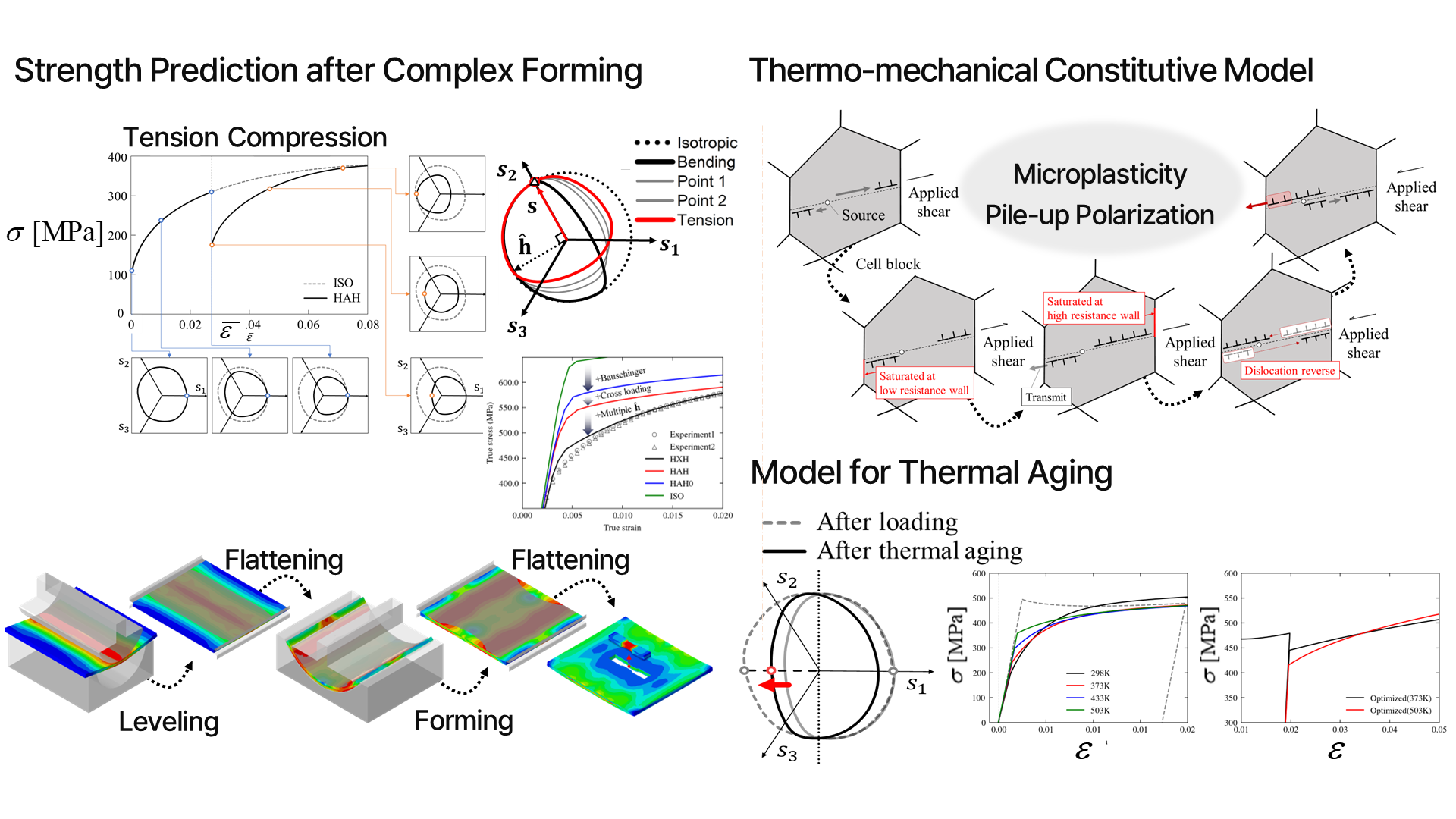
Thermo-Mechanical Anisotropic Hardening and Process Simulation Based on Advanced Constitutive Model
김승우An advanced constitutive modeling framework that predicts thermo-mechanical strength and anisotropic hardening behavior during complex industrial forming processes.
What we do
- Develop an anisotropic distortional hardening model extended with temperature dependency to capture complex material behavior under thermal-mechanical loading.
- Ground macroscopic material responses in dislocation-based micro-mechanisms, such as microplasticity and pile-up polarization, for physical consistency.
- Implement the model into finite element platforms via UMAT for high-accuracy strength prediction in industrial applications like pipe leveling and forming.
Theme 2
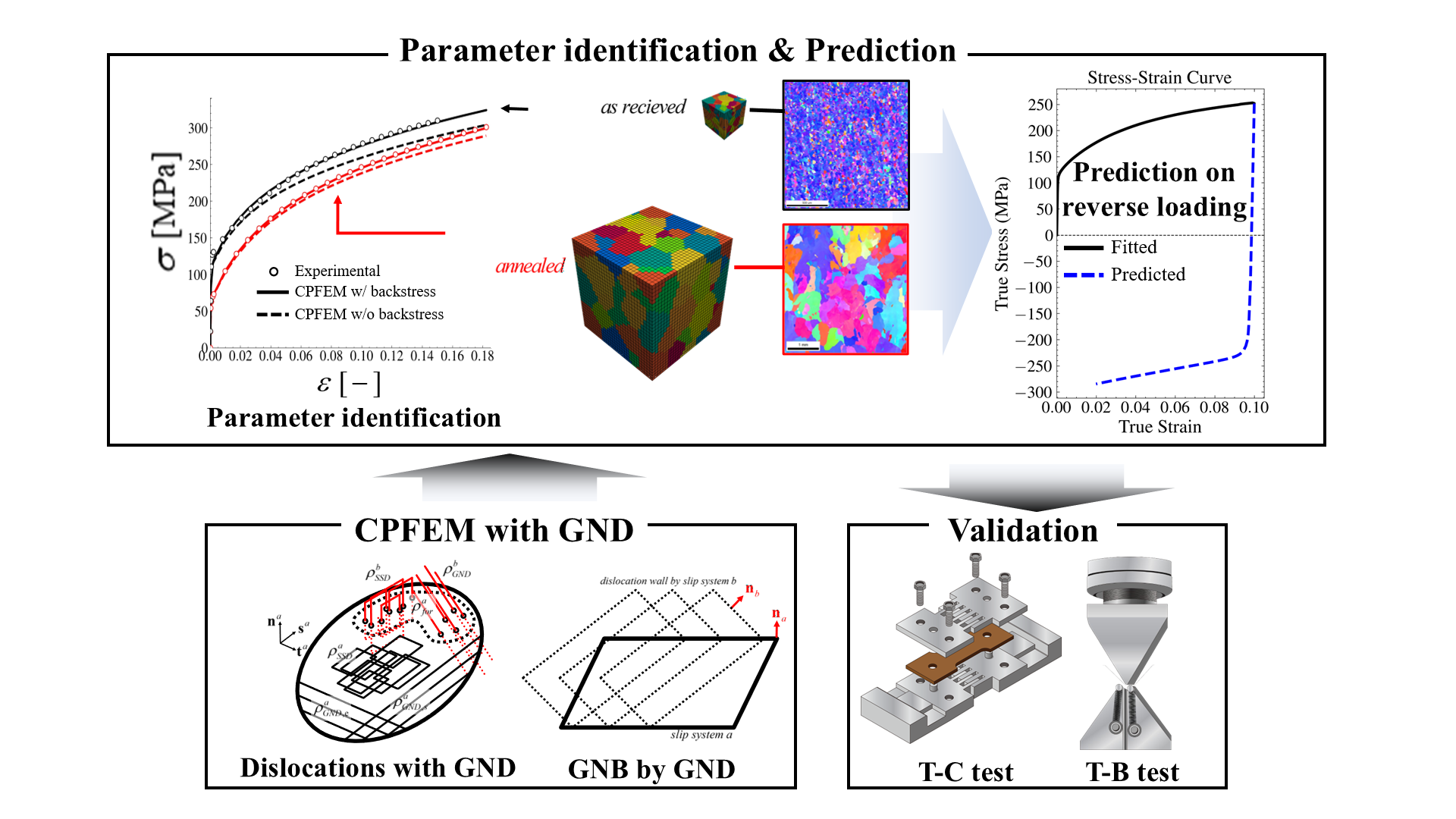
Prediction of intrinsic size effect by strain gradient CPFEM
심규장A strain gradient crystal plasticity finite element (CPFEM) framework that predicts grain size-dependent mechanical behaviors by incorporating dislocation-based long-range interactions.
What we do
- Develop a constitutive model that accounts for the Hall–Petch effect and Bauschinger effect through long-range interactions between dislocations.
- Incorporate a GND(Geometrically Necessary Dislocation)-based back stress model to capture size-dependent hardening and reverse loading responses.
- Validate the predictive accuracy of the framework across different microstructure scales using T-C(Tension-Compression) and T-B(Tension-Bending) test simulations. 3