
Multi-scale modeling
Multi-scale modeling
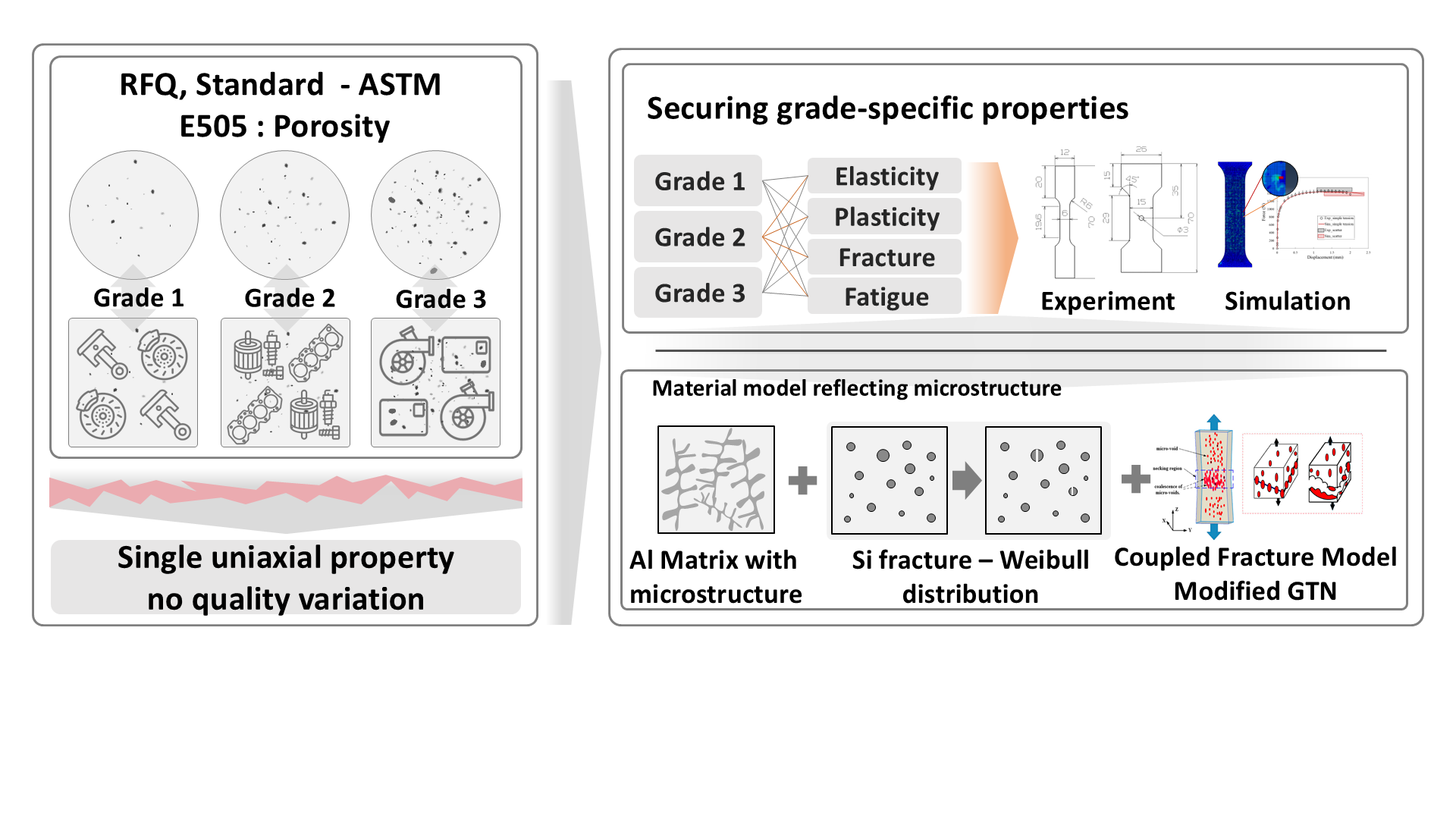
Development of a microstructure-based fracture model for grade-specific properties of cast aluminum alloys
이경민, 홍승효, 이응민A multi-scale fracture modeling framework that predicts failure evolution in die-cast aluminum by integrating ASTM E505 porosity standards with a modified GTN damage criterion.
What we do
- Characterize grade-specific mechanical properties (elasticity, plasticity, and fracture) of aluminum alloys by linking ASTM E505 porosity levels to microstructural variations.
- Incorporate a modified GTN(Gurson-Tvergaard-Needleman) model coupled with Weibull distribution to describe the statistical nature of Si-particle fracture and void evolution.
- Establish a robust simulation-based prediction workflow to evaluate the quality and structural integrity of complex die-cast components under various loading conditions.
Representative Publications
DOI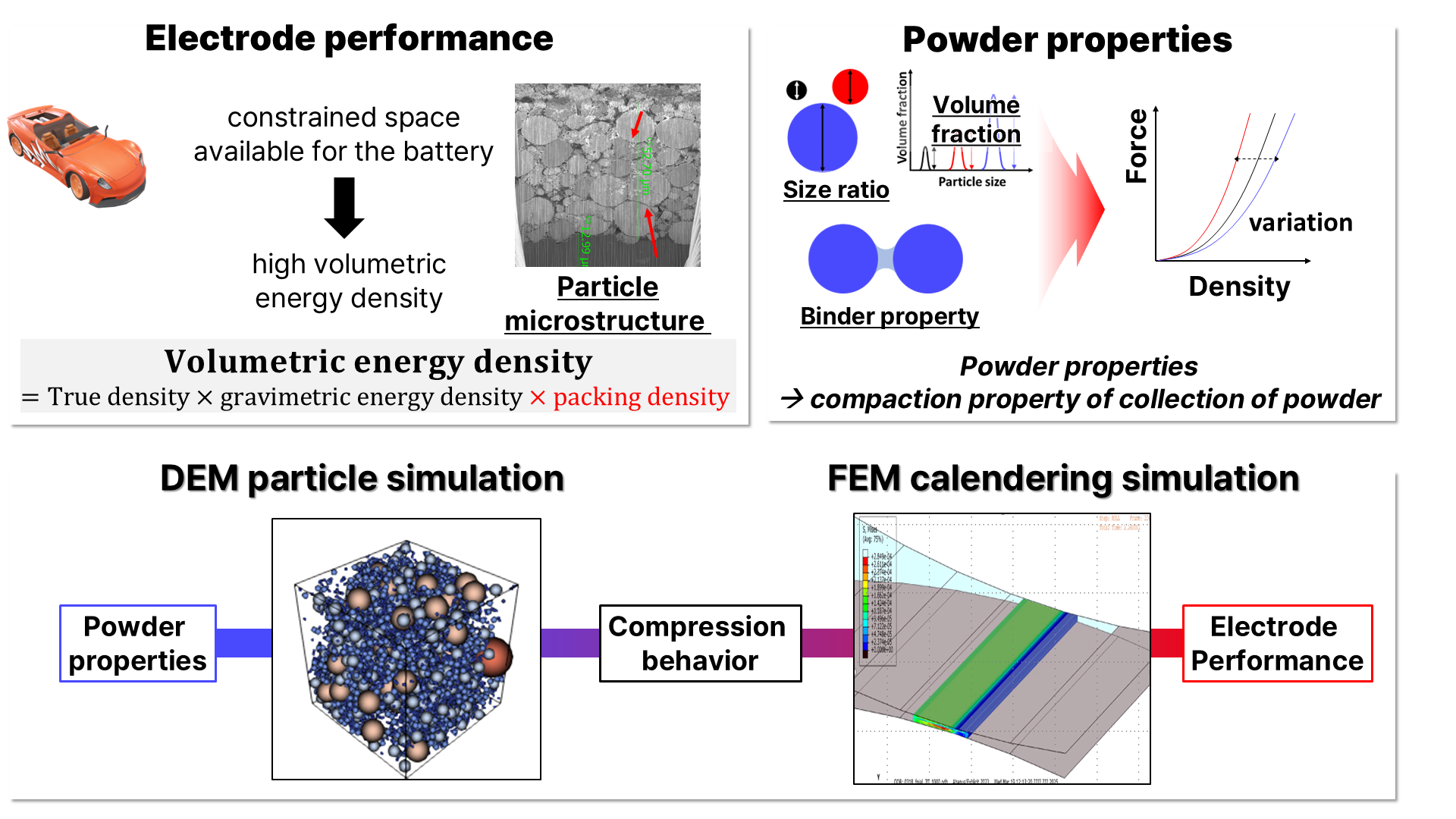
Optimization of Particle Properties for Improvement of Electrode Performance
김태현A multiscale simulation framework that optimizes battery electrode performance by capturing the deformation history and microstructural evolution during the calendering process.
What we do
- Analyze the correlation between powder properties (size ratio, binder properties) and packing density to maximize the volumetric energy density of electrodes.
- Utilize Discrete Element Method (DEM) simulations to model complex particle-level interactions and compression behaviors during the manufacturing stage.
- Integrate FEM calendering simulations to quantify the final electrode performance and structural integrity based on the predicted microstructural changes.
Representative Publications
DOI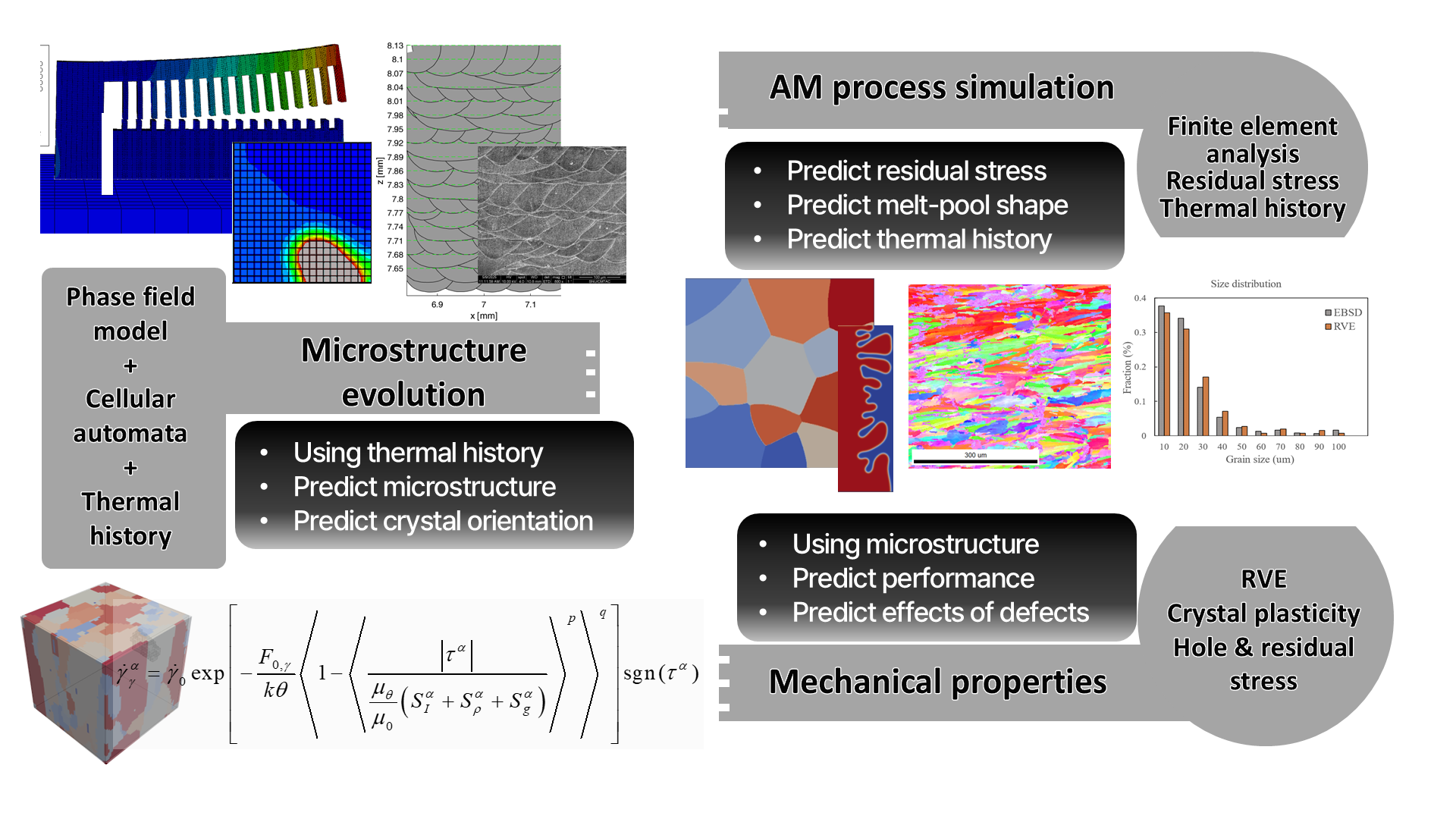
Multi-scale modeling of Additively Manufactured Nickel-Based Superalloy
김형서A comprehensive multi-scale modeling framework for AM nickel-based superalloys that establishes a digital twin by bridging process parameters, microstructure evolution, and final mechanical properties.
What we do
- Develop a coupled simulation workflow using Phase-field and Cellular Automata methods to predict microstructure evolution and crystal orientation based on thermal history.
- Establish a process simulation framework to predict residual stress, melt-pool shapes, and thermal gradients during the additive manufacturing process using finite element analysis.
- Utilize Representative Volume Element (RVE) and Crystal Plasticity models to evaluate the effects of defects and microstructural features on the macroscopic mechanical performance of the superalloy.
Representative Publications
DOI
Simulation of dynamic recrystallization (DRX) considering second-phase particles
이인복A Cellular Automata (CA) based computational framework to simulate dynamic recrystallization kinetics and predict fracture initiation induced by plasticity heterogeneity in metals containing second-phase particles.
What we do
- Develop a Cellular Automata (CA) model that incorporates the pinning and nucleation effects of second-phase particles on grain boundary migration during high-temperature deformation.
- Simulate DRX kinetics and microstructural evolution by considering the competition between dislocation accumulation and grain interior restoration.
- Predict fracture initiation sites by quantifying the plasticity difference and stress concentration between recrystallized and un-recrystallized regions.