
Multi-physics modeling
Multi-physics modeling
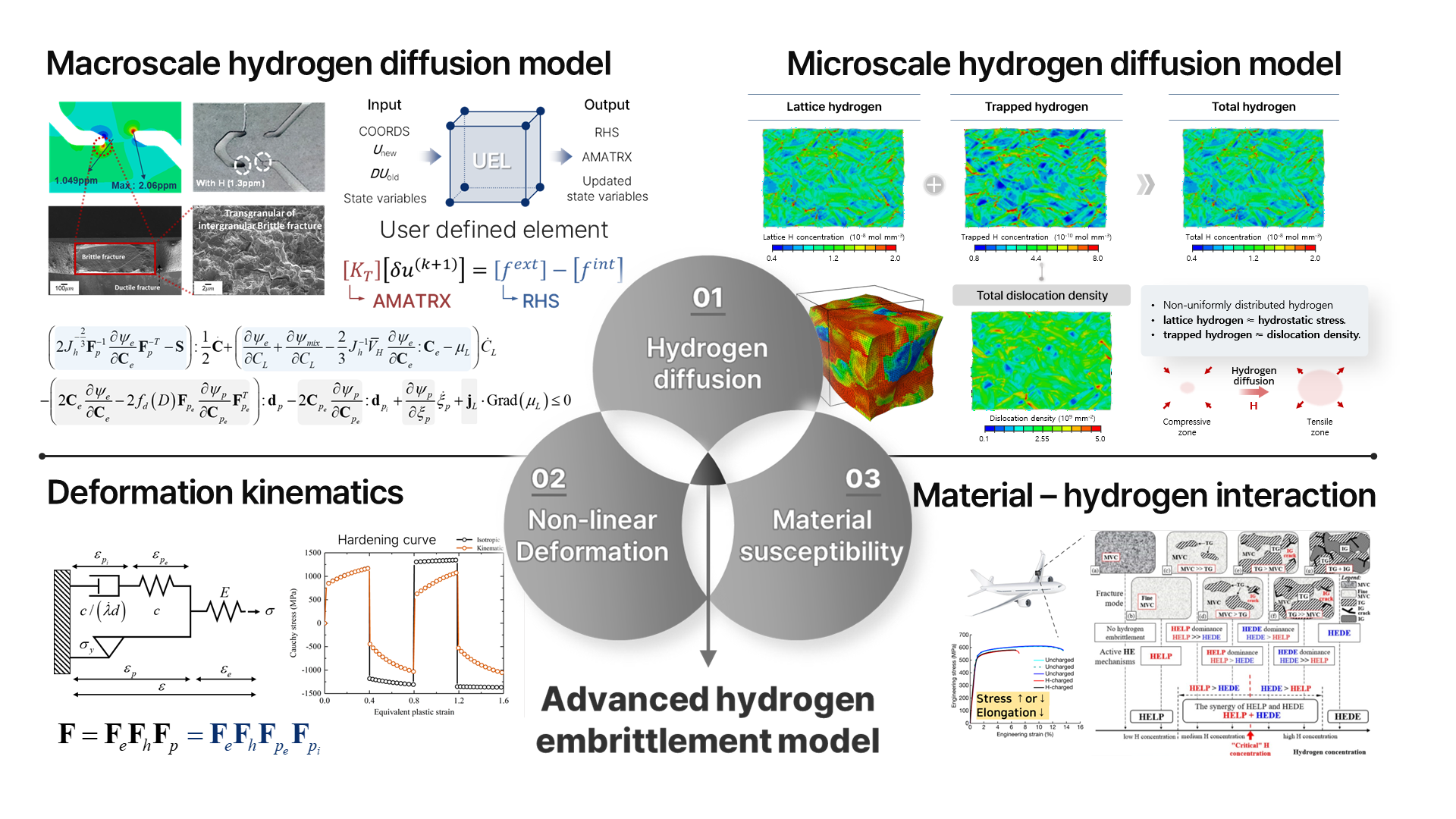
Multi-physics hydrogen embrittlement modeling
신건진A thermodynamically consistent multi-physics modeling framework that predicts hydrogen-induced fracture by coupling diffusion, crystal plasticity, and damage evolution across scales.
What we do
- Develop thermodynamically consistent constitutive models that couple hydrogen diffusion kinetics across scales to capture stress-assisted hydrogen localization.
- Formulate gradient-enhanced damage models to describe hydrogen-induced degradation and the transition from ductile to brittle fracture.
- Implement fully coupled diffusion–plasticity–fracture frameworks in finite element platforms for microstructure-sensitive prediction of hydrogen embrittlement.
Representative Publications
DOI-
Modeling the transition from ductile to brittle fracture induced by hydrogen-assisted mechanical degradation in quenching and partitioning steel
G.Shin, et al. · Engineering Farcture Mechanics · 2025
-
Modeling hydrogen diffusion and its interaction with deformed microstructure involving phase transformation–Theory, numerical formulation, and validation
J.Park, et al. · International Journal of Plasticity · 2025
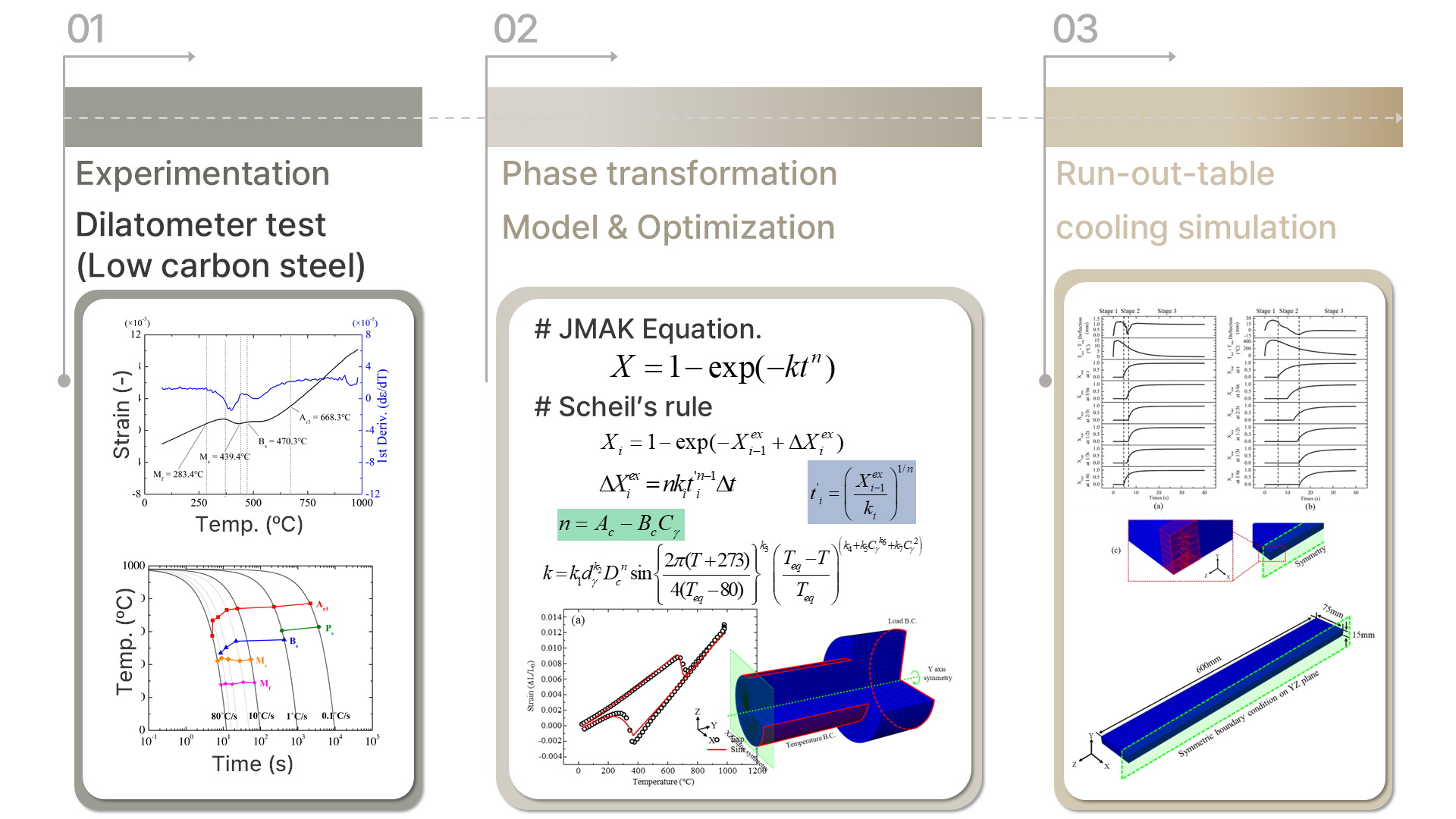
Finite element simulation of steel plate deformation after hot rolling and cooling
구진모A fully coupled thermal-mechanical-metallurgical multiphysics model to predict plate shape evolution and deformation during the run-out-table cooling process.
What we do
- Conduct dilatometer tests on low-carbon steel to characterize phase transformation kinetics and thermal expansion behavior under various cooling rates.
- Implement a metallurgical model utilizing the JMAK equation and Scheil's additivity rule to describe the fraction of phase transformation and latent heat evolution.
- Develop an integrated FE-based simulation workflow for run-out-table (ROT) cooling to accurately predict residual stress and flatness in heavy-gauge steel products.