
Fracture Mechanics
Fracture Mechanics
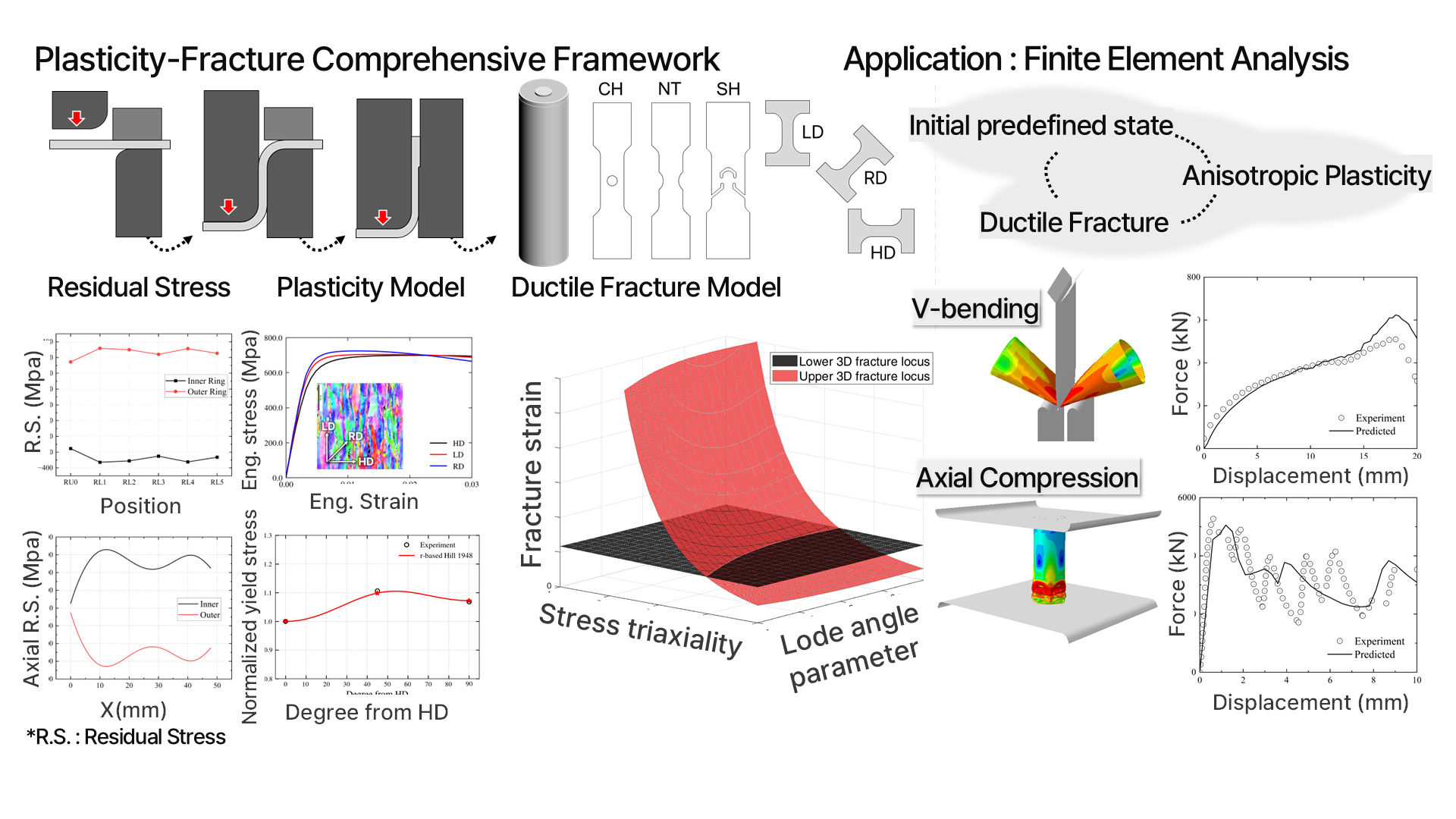
Integrated Plasticity-Fracture Framework for Battery Can Materials
김승우A unified numerical framework for battery can-type materials that integrates advanced plasticity and ductile fracture mechanics to predict structural integrity from the deep-drawing stage to final failure.
What we do
- Establish a comprehensive plasticity-fracture model that accounts for anisotropic hardening and stress state-dependent (stress triaxiality and Lode angle) fracture limits.
- Develop a coupled finite element analysis (FEA) workflow to evaluate the influence of manufacturing-induced residual stresses on the subsequent mechanical performance of battery cans.
- Validate the predictive accuracy of the integrated model through various loading scenarios, including axial compression and V-bending tests, to ensure the safety of battery packaging.
Representative Publications
DOI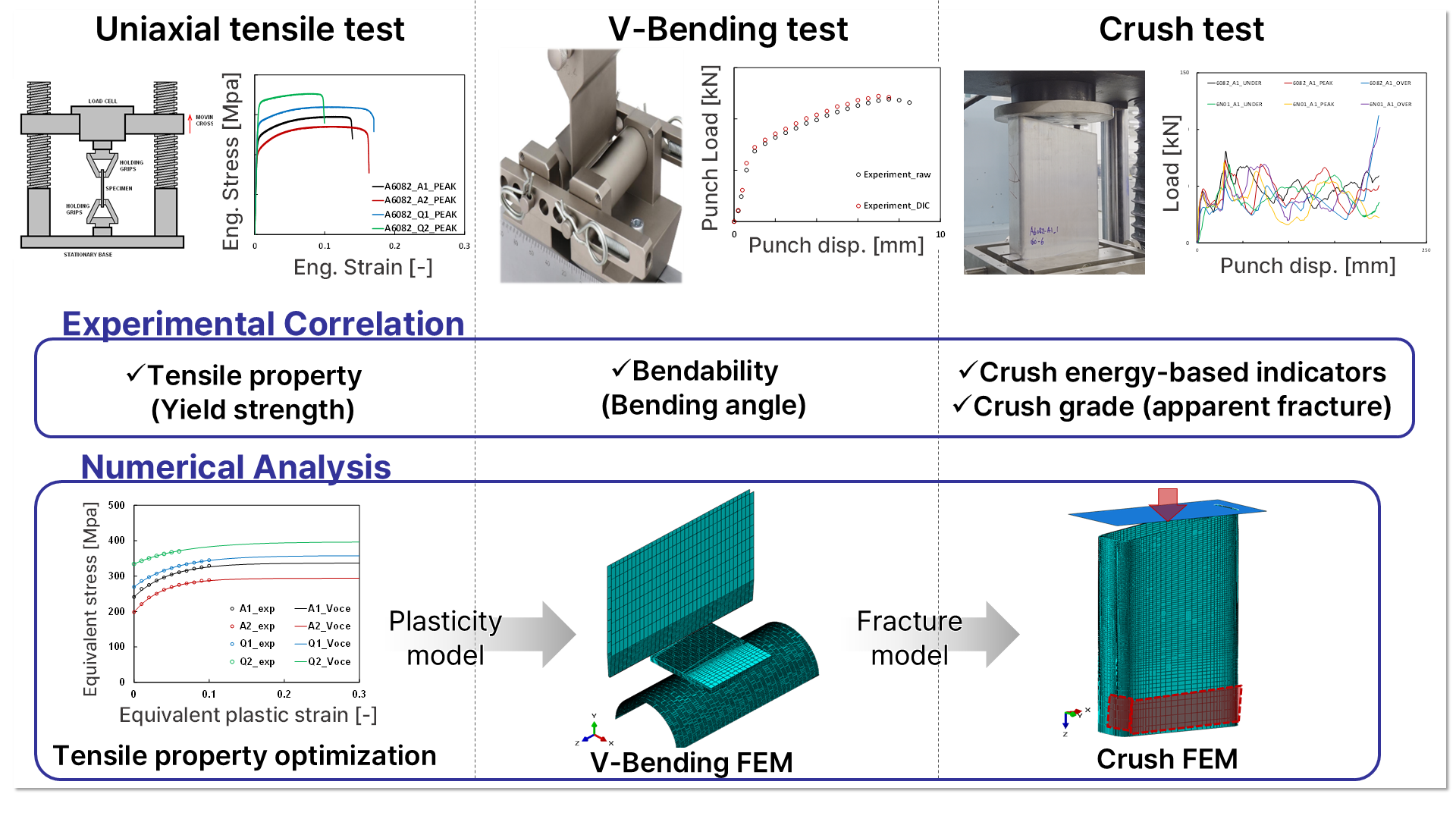
Experimental & numerical correlation between material property and crush performance
백민광A comprehensive evaluation framework that establishes quantitative correlations between fundamental material properties and macroscopic crush performance through integrated experimental testing and validated finite element analysis.
What we do
- Characterize key mechanical indicators, including yield strength, bendability, and energy absorption capacity, through standardized tensile, bending, and crush experiments.
- Develop a new crush-performance indicator that incorporates both energy absorption efficiency and apparent fracture initiation to evaluate material reliability.
- Build and validate a high-fidelity FE model capable of accurately predicting crush behavior by optimizing plasticity and fracture parameters based on material-level experimental data.
Representative Publications
DOI
Evaluation of crush performance of extruded aluminum alloy tubes based on finite element analysis with ductile fracture modeling
원정윤An integrated numerical and experimental framework that evaluates the crashworthiness of extruded aluminum tubes by correlating material-level ductile fracture properties with structural crack-initiation mechanisms.
What we do
- Investigate crack-initiation mechanisms in extruded aluminum alloys under complex, non-proportional stress states through coupled tensile testing and FE simulations.
- Propose modified crush-performance indicators that quantitatively incorporate both energy absorption capacity and the timing of fracture initiation.
- Validate the predictability of the proposed indicators using high-fidelity axial crush FE models, enabling accurate assessment of extrusion crashworthiness in automotive applications.
Representative Publications
DOI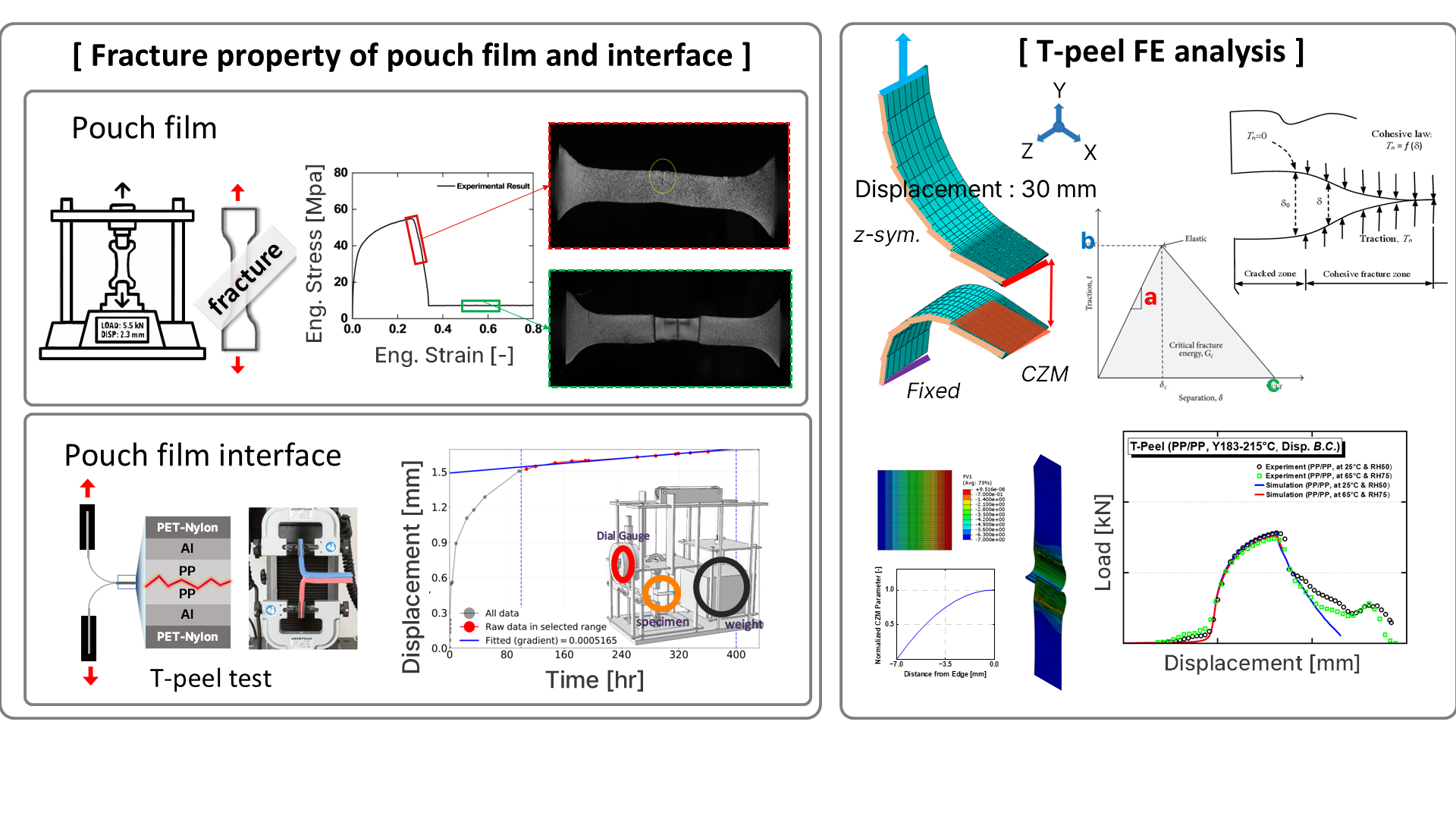
Hydrothermal degradation and T-peel performance of sealing interfaces in battery pouch films
홍승효A predictive simulation framework based on Cohesive Zone Modeling (CZM) to evaluate the mechanical integrity and fracture behavior of battery pouch sealing interfaces under hydrothermal aging conditions.
What we do
- Construct a comprehensive database of mechanical and fracture properties for pouch films and their interfaces through standardized T-peel and tensile testing.
- Develop a CZM-based finite element simulation technology that accurately replicates the peeling process and interface separation under various displacement conditions.
- Establish a technical foundation to predict and mitigate sealing part fractures caused by battery internal pressure and swelling, accounting for long-term environmental degradation.
Representative Publications
DOI
