
Reliability and Failure
Reliability and Failure
Theme 1
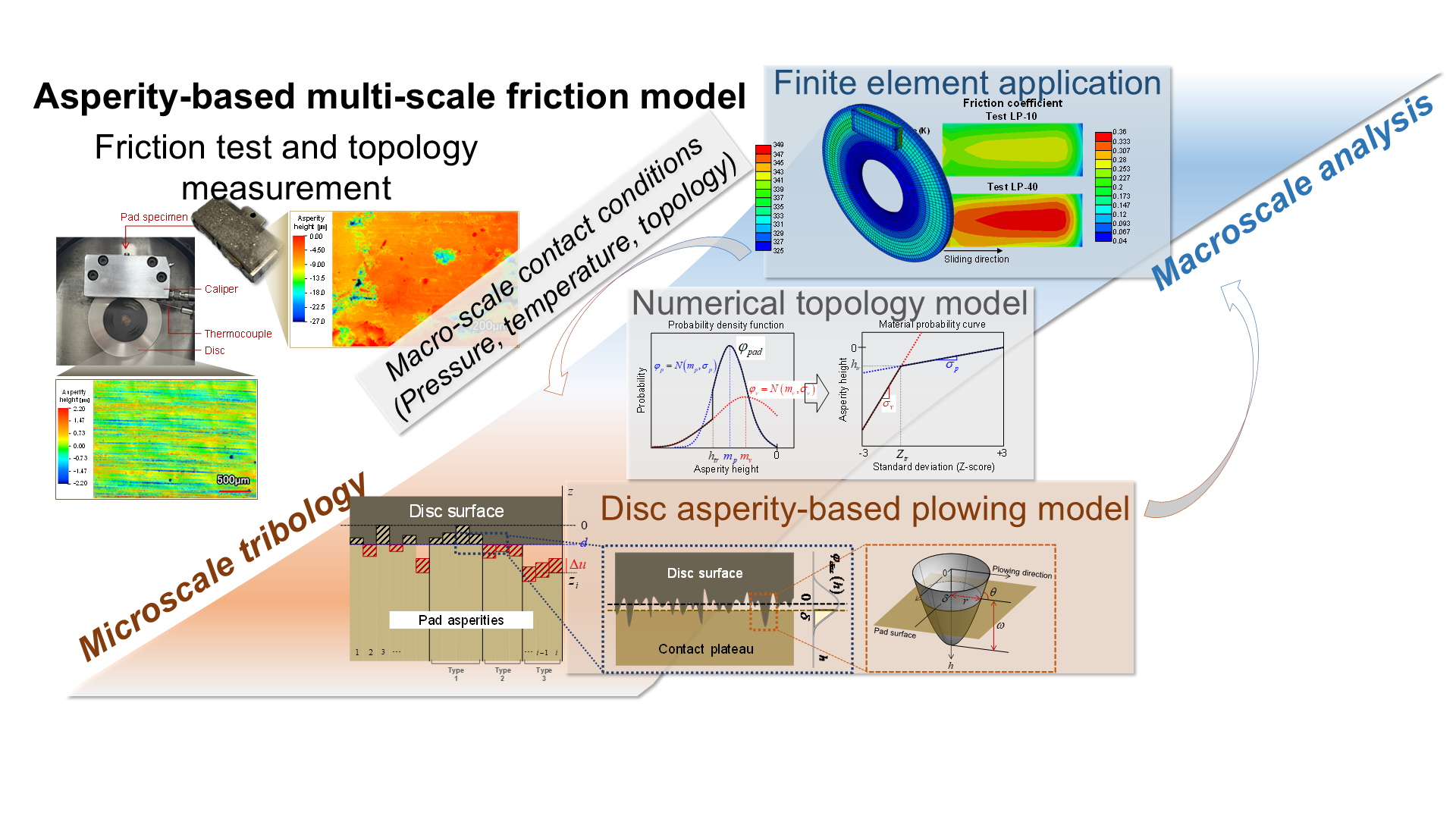
Integrated wear and friction modeling of brake pads using topology evolution
원정윤A multiscale friction modeling framework that links microscale surface asperity interactions and plowing mechanisms to macroscale finite element simulations for predicting the tribological behavior of brake systems.
What we do
- Develop an asperity-based contact model that incorporates microscale surface topology measurements to quantify real contact area and pressure distribution.
- Characterize microscale plowing and wear mechanisms using numerical topology models to establish a physical link between surface roughness and friction coefficients.
- Integrate the microscale tribological laws into macroscale FE simulations to accurately predict the thermal-mechanical behavior and friction stability of brake pads under varying contact conditions.
Representative Publications
DOI
Theme 2
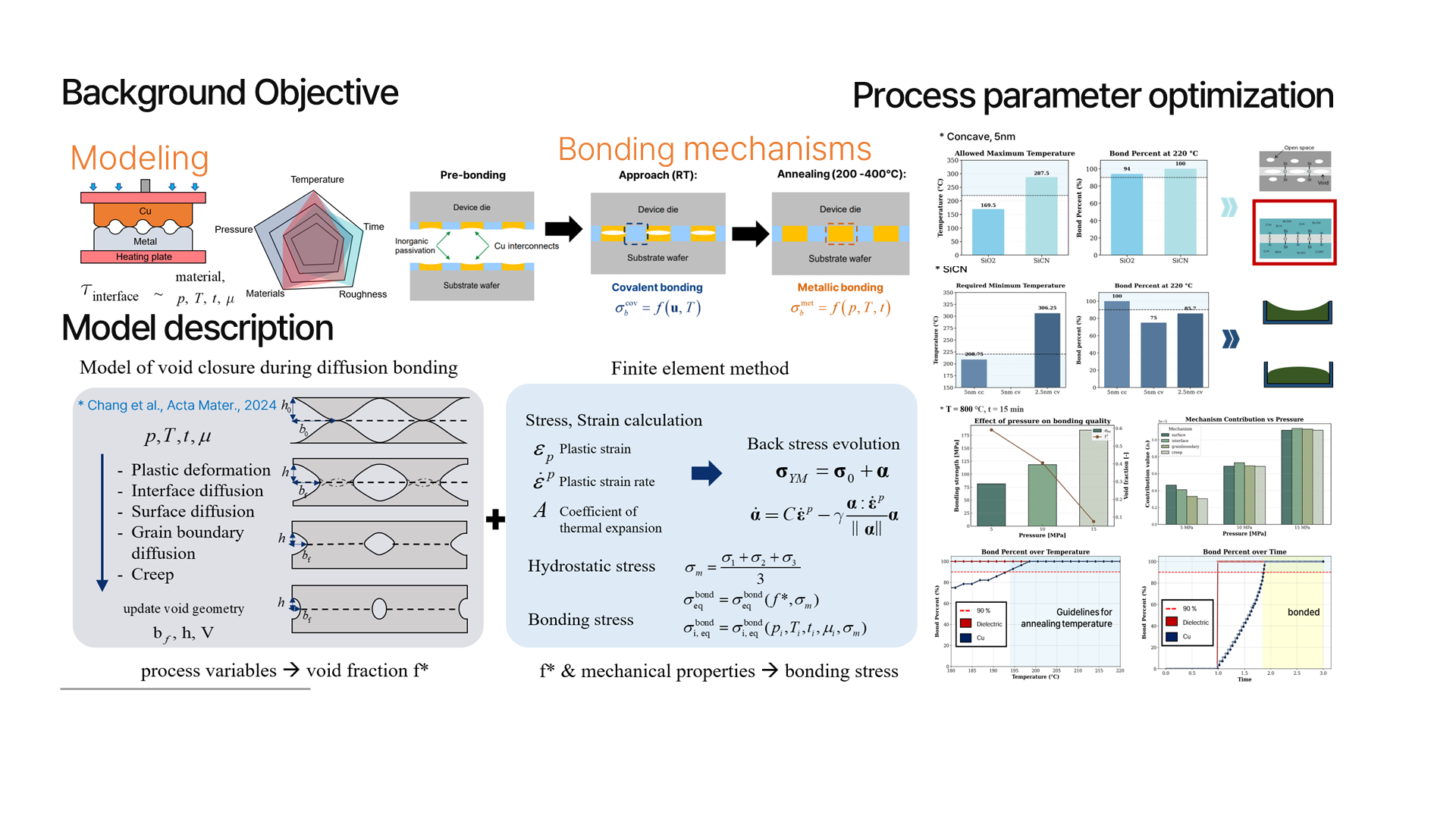
FE-based hybrid bonding interaction modeling
전형주A numerical modeling framework based on the finite element method to analyze the interaction mechanisms between Cu and dielectric materials for optimizing in-process reliability in hybrid bonding.
What we do
- Develop a physical model to describe void closure during the diffusion bonding process by considering plastic deformation, interface/surface diffusion, and creep.
- Implement a multi-physics finite element framework that calculates stress-strain evolution and back-stress development under varying thermal and mechanical loading.
- Establish a process parameter optimization strategy by quantifying the effects of pressure, temperature, and annealing time on the final bonding quality and interface integrity.
Representative Publications
DOI
Theme 3

Microstructural Origins of Surface Defects in Ultra-Low Carbon Steel: Using Crystal Plasticity Finite Element Modeling and Experimental Characterization
최태혁A comprehensive investigation into the microstructural origins of surface defects in ULC steel by coupling Crystal Plasticity FEM (CPFEM) with advanced experimental characterization such as EBSD and nanoindentation.
What we do
- Characterize the influence of microstructural properties, including grain size, crystallographic orientation, and dislocation density, on the localized mechanical response of ULC steel.
- Develop and utilize a CPFEM framework to simulate the heterogeneous deformation behavior of different microstructures and predict potential defect formation sites.
- Validate the numerical predictions through multi-scale experimental analysis, integrating surface observation, EBSD orientation mapping, and nanoindentation tests to confirm the fidelity of the model.
Representative Publications
DOI

